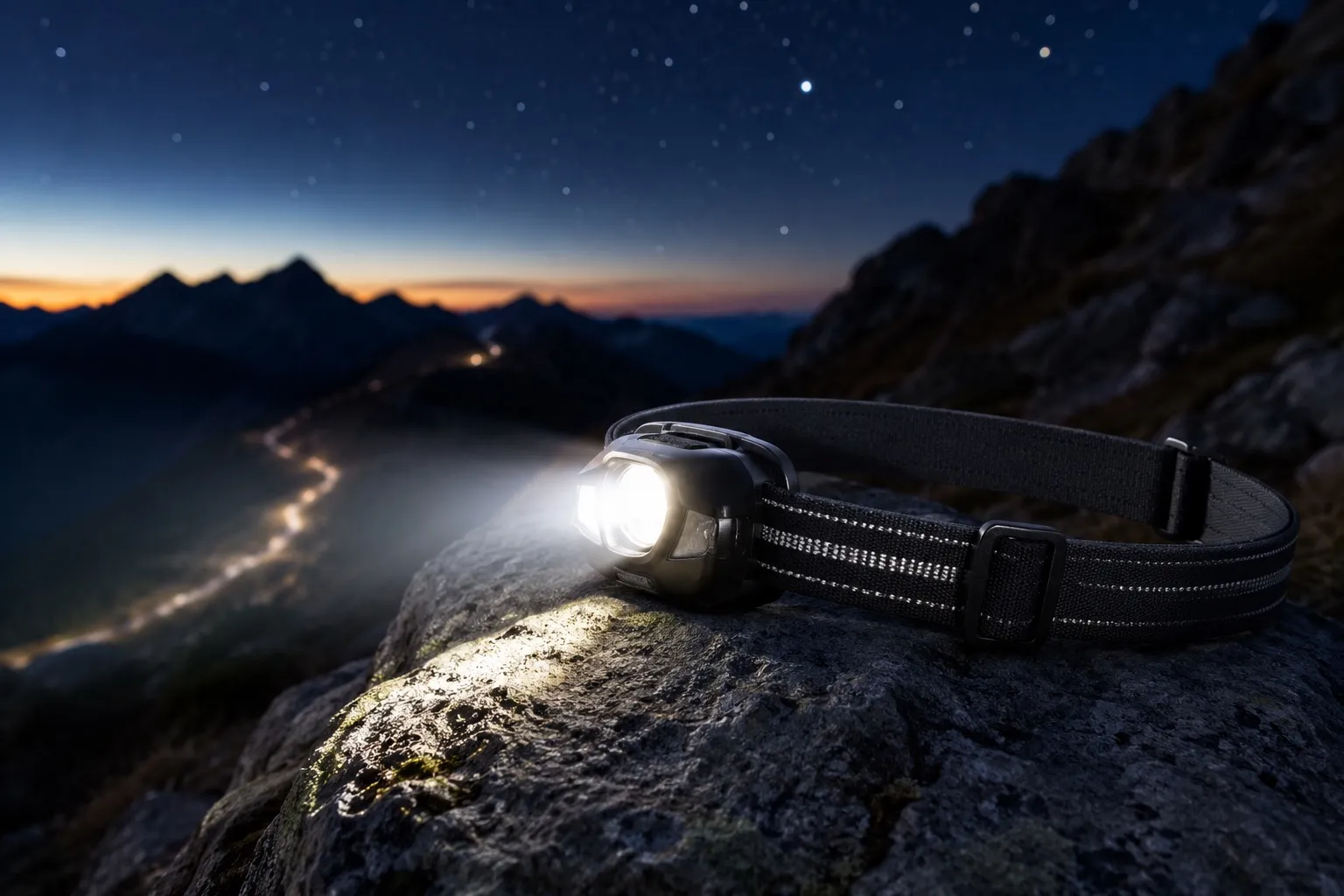
Walking at night completely changes the mountains: the silence, the stars, the cool air in summer. But it all hinges on a small piece of kit that gets underrated until it fails: the headlamp. After several night crossings and a few early starts to catch summit sunrises, here’s what really matters when choosing one.
Lumens aren’t everything
The lumen figure sells, but it’s misleading. Three things matter more:
- Sustained lumens, not the peak. Many headlamps advertise 400 lm that they only hold for 30 seconds before dropping to avoid overheating. Look at the sustained output.
- The beam: a wide beam to see the trail right in front of you and your feet, plus some throw to pick out landmarks in the distance. Ideally it combines both.
- Colour temperature: a slightly warm light is less tiring on the eyes over long distances.
For normal night hiking, 150–250 sustained lumens are plenty. More lumens only make sense for running or very technical terrain.
Runtime and battery type
- Work out your longest night and double the margin. Running out of light halfway down is dangerous.
- AAA batteries: you swap them on the spot, ideal for long expeditions without a plug.
- Rechargeable battery (USB-C): more convenient and cheaper in the long run, but it depends on charging it properly beforehand and, in extreme cold, it loses performance.
- Hybrid models (rechargeable battery + the option of batteries) are the most versatile.
The cold matters
In winter, lithium battery performance drops. If you go bivouacking or head out in the cold, keep the headlamp close to your body until you use it and consider a model with a detachable battery you can stash in an inner pocket. And dress well: master the three-layer system so you don’t get cold at your stops.
Red light: more useful than it looks
The red light mode doesn’t wreck your night vision and doesn’t bother whoever is walking behind you. For moving around camp, reading the map or a bivouac, it’s perfect. Make sure your headlamp has it.
Details you appreciate at night
- Button lock so it doesn’t switch on by itself in your pack and leave you with a dead battery.
- Mode memory: it turns on at the level you left it, not at full blast dazzling everyone.
- Water resistance (at least IPX4) for rain and sweat.
- A comfortable strap and balanced weight; very heavy front-mounted lamps sag.
My summary
- Look for 150–250 sustained lumens, not the marketing peak.
- Make sure of real runtime for your longest night, with margin.
- Get one with red light and a button lock.
- Decide batteries or rechargeable based on how and where you go out.
A good headlamp isn’t the most powerful one: it’s the one that gives you reliable light, all night, no surprises. And always, always, carry a backup light source, even a tiny one.
Keep reading
- Common night hiking mistakes: the headlamp is just one; avoid the rest.
- The three-layer system: how to dress so you don’t get cold at night.
- How to plan your first bivouac: if the night outing ends in an overnight stay.